
Generally speaking, startups in China are geniuses at selling themselves big regardless of their developmental stage. It’s often hard to tell how great they really are – even if you’ve lived in China for quite some time.
While this can also happen to you in the UK, the US or the EU, as western analysts in our home markets we can mostly rely on our experience, expert networks and proven evaluation tools to quickly get to the very core and substance of the startup candidate we’re looking at. What’s more, finding trustworthy information is usually easy. – Not so in China.
Evaluating Chinese startups – a challenge, but fun!
As a foreigner, evaluating Chinese companies will always be challenging, no matter how rich your China experience and Mandarin skills might be.
Our limited access to truly Chinese networks, differences in data accessibility and limited transparency on early-stage innovation activities are major hurdles to overcome.
But here’s the good news: Even if you’re a novice to China topics, the evaluation of Chinese startups can still be cracked. Dare to try it! – You might even end up having fun. 😉
Anyone can do it – here’s what you need.
While researching Chinese tech targets is all about applying the right tricks, you do need a solid foundation as an analyst to make this work.
Apart from experience in market research, here are the 2 things you should bring:
- pragmatism,
- a detective’s mindset (thus the ability to collect proof and draw one’s own conclusions).
In other words: This challenge is exactly for you if a bit of mystery doesn’t stop you but gives you the extra kick to move on.
Are you determined to join in as our “partner in crime”?
Then your training as a startup detective has herewith begun!
Know the basics before diving in.
It’s time for us to share our magic workarounds with you to make you the best Chinese startup analyst you can become.

Trick #1: Evaluating Chinese startups is tricky, evaluating Chinese VCs not so much.
Even the great Sherlock Holmes would have been a poor detective without the local people giving him the right hints & advice. – And that’s what you need!
You’ll want to find people who:
- speak Mandarin at mother-tongue level,
- have access to Chinese networks and insider tips,
- know China’s data sources and information landscape inside out,
- have decades of expertise in Chinese deep tech evaluation.
Plus, you want these people to share their best insights & bets with you in a transparent way and for free!
Spoiler: Foreigners are NOT the experts you want.
It’s the Chinese VCs that you need!
If you’re looking at a selective company, this quality stamp’s all you need.
If you’re aiming at analysing bigger datasets of multiple startup companies at the same time (e.g. funding round data), narrowing them down to the most promising based on your own shortlist of top Chinese VC investors, is the road you should take.
Chinese VC shortlist for deep tech investments:
We’ve tested this approach on thousands of Chinese funding rounds ourselves. If you want to find out which Chinese VC investments are the best quality stamp for deep tech topics, you might want to check out our own selection of the Top Chinese VCs investing in deep tech startups
Trick #2: Reading Chinese content gets easy with translation tools.
With English as our shared language, access to information has never been a real challenge for us before. Our websites are multilingual, local and English versions are a 99% match.
In China, you’ll be surprised to find websites in Mandarin only. This particularly applies to the websites of Chinese early-stage startups. If bilingual content is offered, English and Mandarin descriptions sometimes have little overlap.
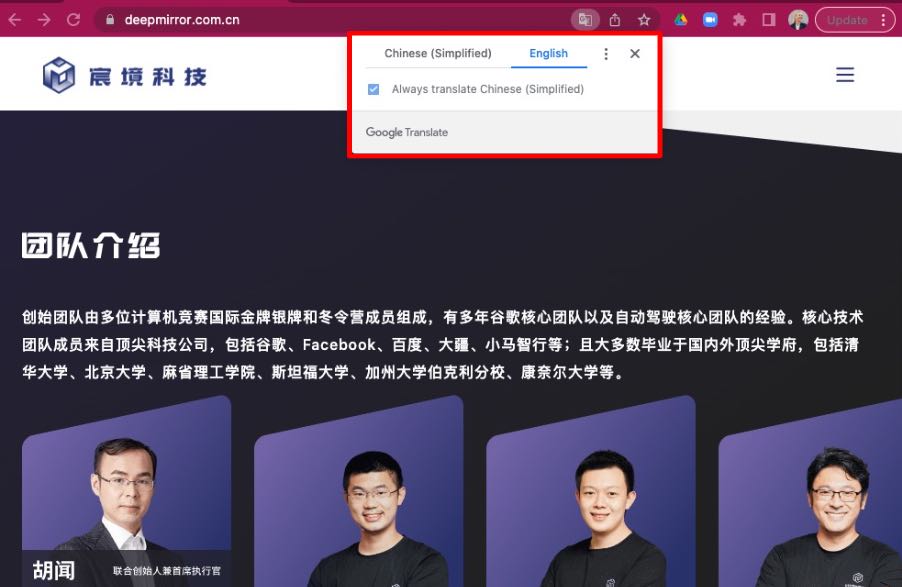
Using a translation tool does the trick! – While you may find this obvious, few people in the west would actually think of it.
Using a translation tool is THE key to understanding the core of the startup candidate you’re looking at. While Google translate used on Chome may not be working in some cases because of China’s separated internet, you might want to try via Microsoft Edge browser which often provides easier access.
Starting from series B stage, Chinese startups usually run bilingual websites hosted on international servers. However, you might still want to compare the English and the Chinese content version, as in some cases English versions are not as exhaustive and content rich.
Trick #3: Finding relevant content is possible with the right mix of search engines.
You’ll find content with Google or Bing, you’ll have access to more content and platforms with the Chinese equivalents.
Checking the internet, you will find various rankings of Chinese search engines and browsers. Here are the ones we’ve tested and found most useful for the matter of startup evaluation:
(Working well on desktop and mobile.)
Trick #4: Getting to a company’s core with TianYanCha (天眼查).
While search engines grant you access to the publicly available information which is foremost media content (images, video content, news etc.), you might also want to check the “hard facts” of the startup company you’re researching.
The Chinese online company register TianYanCha (天眼查) is available on a subscription basis for little money and gives you insights into information like c-level, company structure, registered capital, shareholding, raised capital and much more. It’s optimised for mobile usage, so we recommend to download the TianYanCha app to your phone and start registering from there.
It’s as easy as this, and now you’re all set. – Don’t wait any longer and start now diving in!