
Europe is not only competing against individual startups, but against industrialisation systems.
Over the past weeks, I started building the first prototype of what I call:
Europe’s Competitive Intelligence Layer in Deep Tech.
The original goal was simple:
help European deep-tech scale-ups stay ahead of the curve by understanding how technologies move from:
| prototype → pilot → deployment → scale |
While building the first MedTech prototype, one thing became increasingly obvious:
Europe is not only competing against individual startups.
We are increasingly competing against industrialisation systems.
That means the relevant question is no longer only:
- Who invented something first?
- Who raised the largest funding round?
- Who published the best research paper?
But increasingly:
- Which systems iterate fastest?
- Which systems compress validation cycles?
- Which systems connect AI, automation, experimentation, manufacturing, and deployment most effectively?
- Which systems turn scientific capability into scalable execution infrastructure?
This became particularly visible while mapping emerging Chinese MedTech execution signals.
One of the more surprising observations was that industrialisation density and execution maturity are not the same thing.
China’s system appears capable of generating significantly more:
- industrialisation attempts,
- deployment trajectories,
- and outward-facing deep-tech companies
than most European ecosystems.
But this also creates a new intelligence problem:
distinguishing signaling intensity from genuine execution maturity becomes increasingly difficult.
The MedTech Execution Map Prototype
The first prototype mapped companies according to industrialisation stage and execution signal density.
Early MedTech Execution Signals
| Stage | Company | Signal | Strategic Observation |
| Deployment | 剂泰科技 (METiS TechBio) | early internationalisation signals | AI-native therapeutic infrastructure positioning narratives with outward-facing signals |
| Deployment | 蓝纳成 | Clinical execution | Transition from development into real-world validation |
| Pilot | 维纳丝医疗 | Clinical validation | Movement into formal validation environments |
| Prototype | 瞳沐医疗 | Surgical robotics funding | Early execution signals in robotics-assisted intervention systems |
| Prototype | 软馨生物 | Biomaterials funding | Early-stage regenerative medicine capability formation |
Early execution and internationalisation signals across Chinese MedTech companies.
Note: Strong activity signals do not necessarily imply mature execution capability.
Industrialisation Progression Framework
| prototype → pilot → deployment → scale |
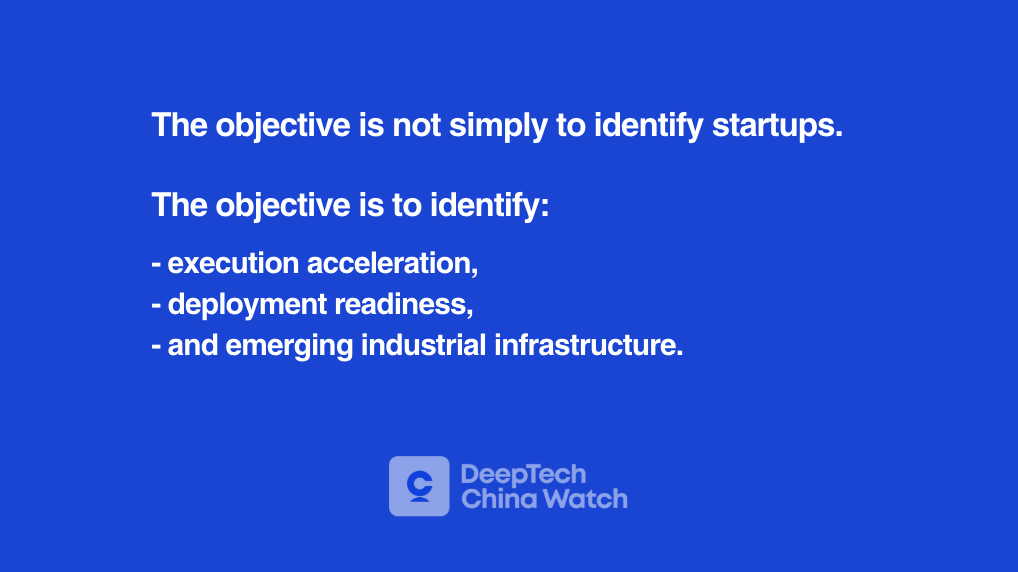
The goal of the system is not simply to identify startups.
It is to identify:
- where execution capability is accelerating,
- where deployment readiness becomes visible,
- and which companies are beginning to build scalable industrial infrastructure.
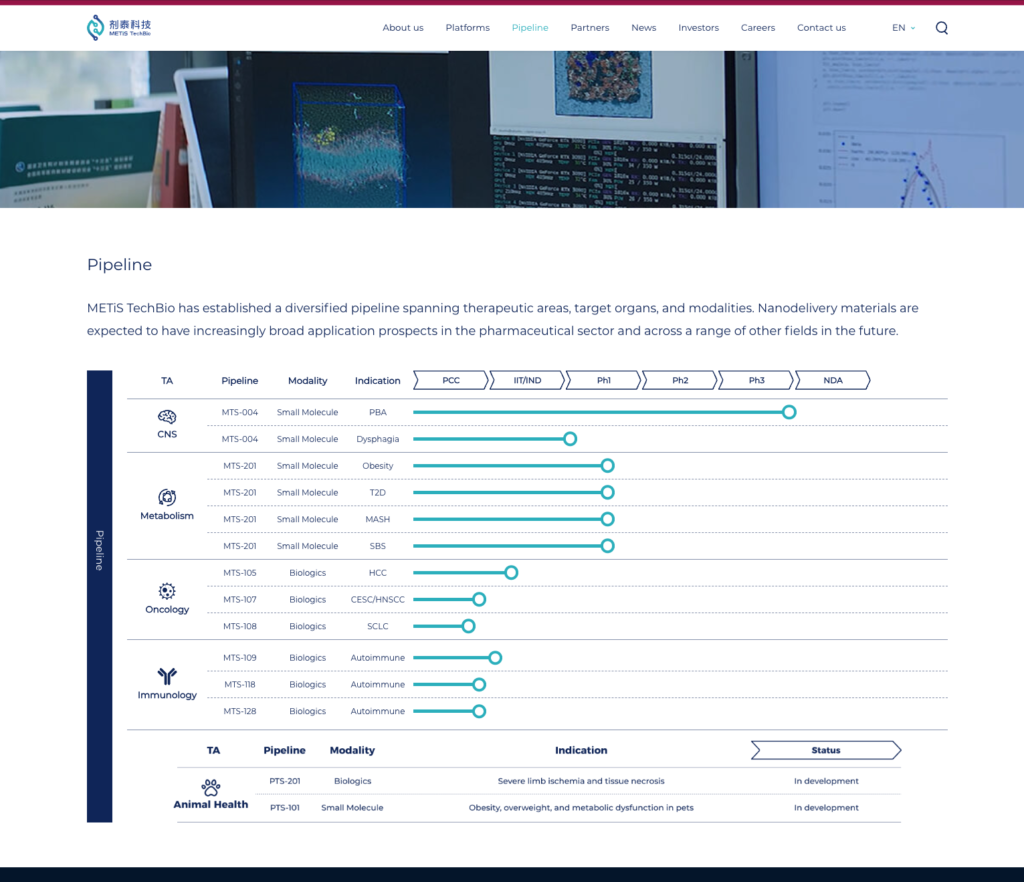
Why METiS TechBio Stood Out
At first glance, many European observers would probably categorize METiS TechBio as: “another AI drug discovery startup.”
But the company became interesting for a different reason.
Not necessarily because it already represents a globally mature industrial player.
But because it reflects a broader industrialisation pattern increasingly visible across parts of China’s deep-tech ecosystem:
AI-native, execution-oriented company architectures optimized around iteration speed and industrial capability formation.
Interpreting Signal Quality Carefully
At the same time, it is important not to overinterpret early-stage activity signals.
Many Chinese deep-tech companies generate strong visibility through:
- awards and prizes
- ecosystem recognition
- accelerator participation
- AI-platform narratives
- media amplification
- startup ecosystem signaling
while actual execution maturity and international operational capability can remain much more difficult to assess externally.
METiS itself still largely resembles a typical high-visibility early-stage Chinese startup ecosystem company:
- primarily Chinese communication infrastructure
- partially translated international presence
- limited visible international organizational maturity
- no clearly established global commercial infrastructure yet
This distinction is important because genuinely internationalising Chinese deep-tech companies often show different structural patterns:
- independent English-language websites
- internationally mature branding
- overseas commercial teams
- globally visible leadership
- sophisticated LinkedIn presence
- localized communication infrastructure
One of the central challenges of competitive intelligence is therefore distinguishing between:
- activity signals,
- signaling intensity,
- and genuine execution maturity.
That distinction becomes strategically important when trying to assess future competitiveness.
The strategic advantage of China’s system may therefore lie less in guaranteeing stronger companies, and more in generating significantly more industrialisation attempts, faster iteration cycles, and denser execution environments.
Understanding which companies are genuinely progressing through these systems becomes the real intelligence challenge.
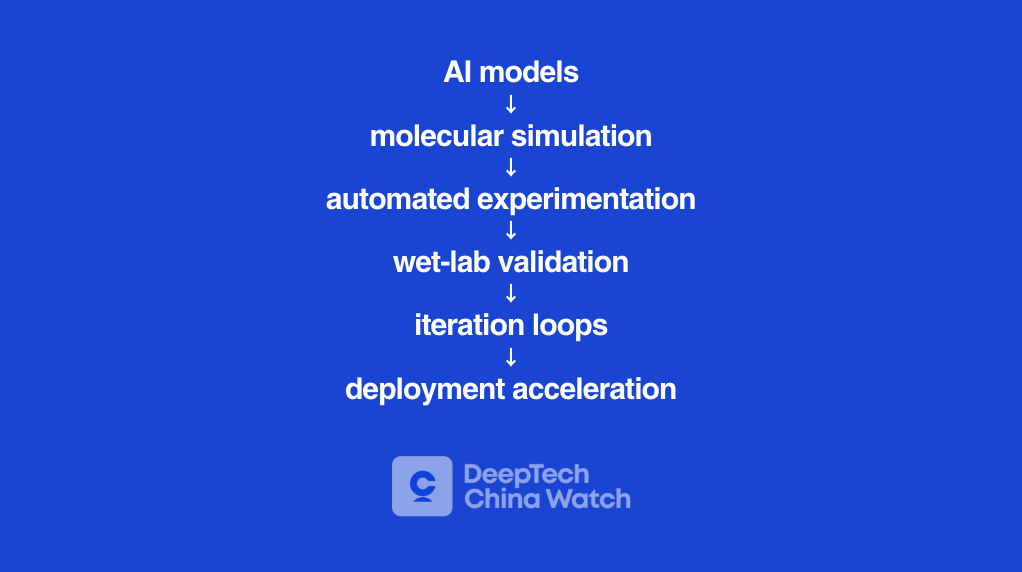
1. AI + Wet Lab + Simulation Feedback Loops
One of the more interesting patterns in METiS’ positioning is the repeated emphasis on:
- molecular simulation,
- AI-guided formulation,
- automated experimentation,
- high-throughput iteration,
- and integrated wet-lab execution.
This is strategically important because the potential advantage does not primarily come from AI alone.
It comes from controlling the feedback loop between:
| computation ↔ experimentation ↔ iteration ↔ deployment |
Instead of positioning AI simply as: “a productivity tool for researchers,” the architecture increasingly resembles industrial AI systems.
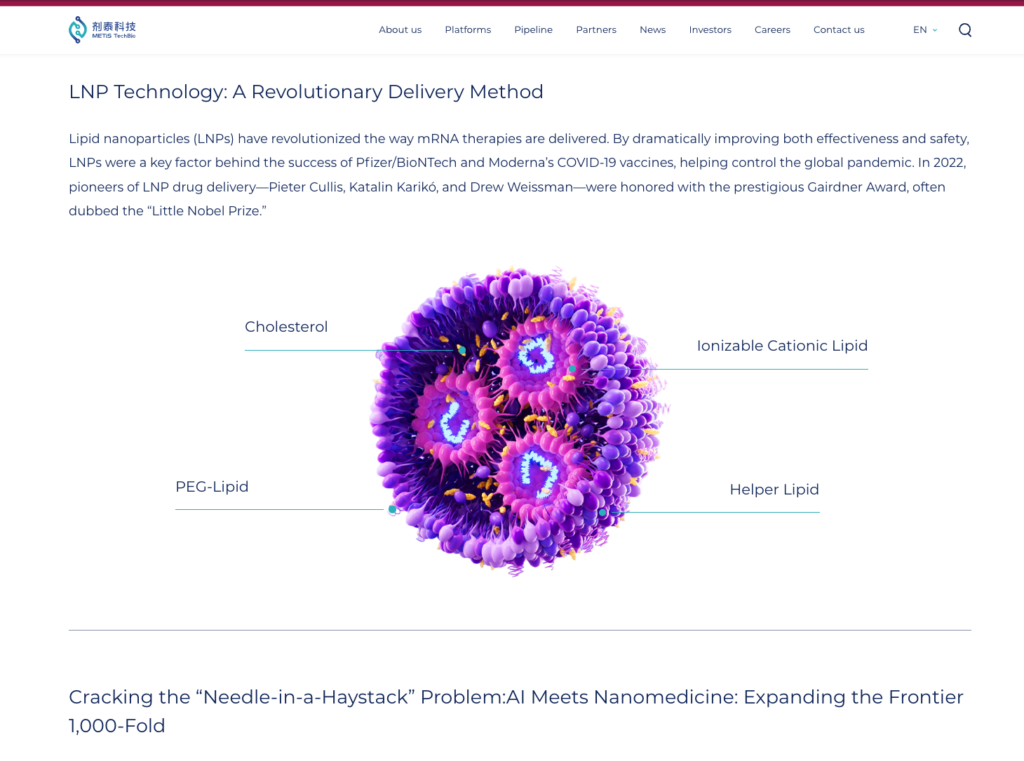
2. Focus On Delivery Infrastructure
Another notable signal is the company’s emphasis on delivery systems:
- lipid nanoparticles (LNPs),
- RNA delivery,
- formulation engineering,
- and programmable therapeutic transport.
This matters because delivery increasingly represents one of the core bottlenecks in:
- mRNA therapeutics,
- gene editing,
- RNA medicine,
- precision oncology,
- and targeted therapeutics.
The implication is less about who discovers molecules first, and more about who industrialises therapeutic delivery infrastructure most effectively.
| The future competitive advantage may belong to whoever industrialises therapeutic delivery infrastructure most effectively. |
3. Platform Logic Instead Of Asset Logic
Traditional biotech companies are often evaluated based on:
- pipeline assets,
- lead candidates,
- or clinical milestones.
METiS increasingly looks more like:
- a platform company,
- an infrastructure layer,
- or an industrial capability stack.
Examples highlighted across the company’s materials include:
- AiLNP
- AiRNA
- NanoForge
- AI-native formulation systems
| This is strategically significant because platform companies can compound capabilities much faster than isolated single-asset organisations. |
4. Industrialisation Velocity As Strategic KPI
One of the clearest patterns across the company’s positioning is the emphasis on:
- shortening iteration cycles,
- accelerating formulation optimization,
- reducing validation timelines,
- and compressing development speed.
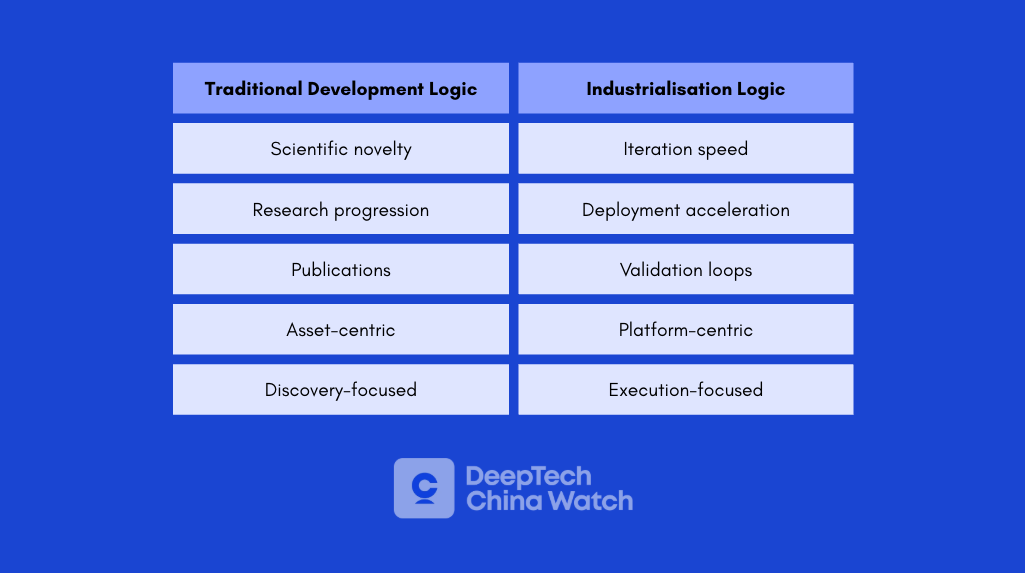
The strategic KPI increasingly appears to be: industrialisation velocity. Not just scientific novelty.
Industrialisation Logic vs Traditional Development Logic
How This Differs From Many European DeepTech Systems
Europe remains exceptionally strong in:
- scientific research,
- advanced engineering,
- industrial quality,
- technical depth,
- and regulatory sophistication.
But many European systems still optimise primarily around:
- research excellence,
- breakthrough novelty,
- publications,
- and upstream innovation.
Companies like METiS appear optimised around:
| iteration density execution acceleration, deployment speed, AI-driven experimentation, and commercialisation infrastructure. |
This does not necessarily mean individual Chinese companies are always stronger.
Nor does it mean Europe should simply “copy China.”
But it does suggest that China increasingly functions as a large-scale industrialisation environment where technologies move from:
| prototype → pilot → deployment → scale |
at unusually high speed and density.
Why This Matters Beyond MedTech
The broader implication goes far beyond biotech.
What appears to matter is not only the quality of individual firms, but the density and speed at which these systems generate experimentation, deployment, and iteration.
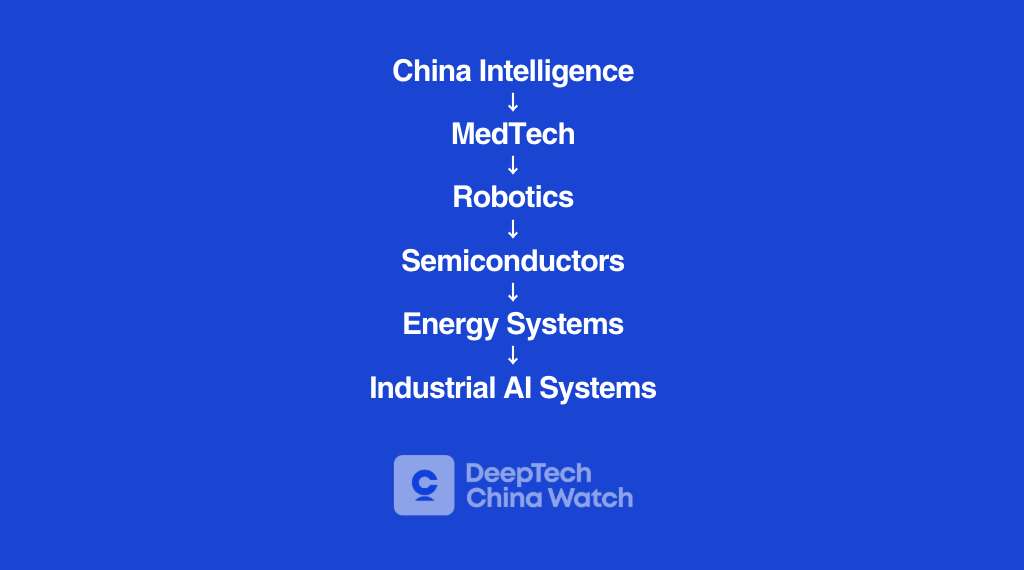
The same structural logic increasingly appears across:
- robotics,
- semiconductors,
- energy systems,
- industrial automation,
- advanced manufacturing,
- and AI-native physical systems.
| The key competitive question increasingly becomes: Which systems are best at industrialising technology? |
Not simply: Which systems invent technology first?
The Role Of Competitive Intelligence
Most deep-tech analysis today still focuses primarily on:
- funding rounds,
- startup announcements,
- market narratives,
- or isolated technology breakthroughs.
But increasingly, strategic competitiveness may depend on understanding:
| industrialisation dynamics, execution systems, deployment architectures, commercialization pathways, and capability scaling trajectories. |
That is one of the reasons I started building Europe’s Competitive Intelligence Layer in Deep Tech.
The MedTech prototype is still early.
But it already validates something important:
| Execution-oriented intelligence can be structured systematically. |
And Europe likely needs much stronger visibility into how global deep-tech industrialisation systems are evolving.
Final Observation
The future competitive advantage in deep tech may not primarily come from isolated breakthroughs.
It may increasingly emerge from systems that:
- generate large numbers of industrialisation attempts,
- compress iteration cycles,
- and integrate experimentation with deployment at scale.
In that environment, the strategic challenge is no longer only identifying promising companies.
It is distinguishing:
- visibility from maturity,
- signaling from execution,
- and experimentation density from genuine industrial capability.
That is ultimately what this work is trying to understand.
MedTech Prototype — Evidence Layer
Industrialisation Stage Mapping

Signal Quality Matrix

More evidence available upon request (bettina@niucapadvisory.com).