
Diving into Chinese Clusters Shaping The World
China’s deep-tech ecosystem is highly geographic. Instead of one national hub, different cities specialize in specific parts of the technology commercialization pipeline.
Below are the 12 clusters that currently matter most globally, and what they dominate technologically. These are the clusters a system like China-Watch should monitor closely. 🌏
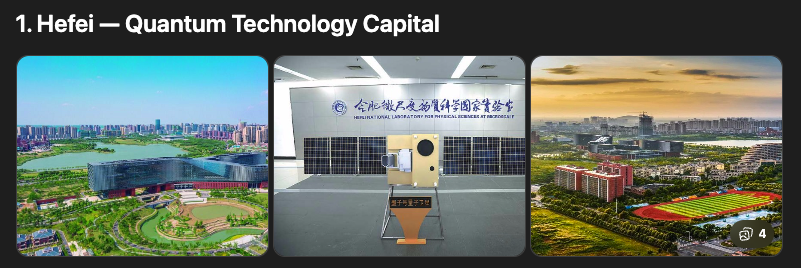
Key anchor: University of Science and Technology of China
Why it matters
Hefei represents China’s most successful science → commercialization pipeline in deep tech. China already operates the world’s largest quantum communication network and has demonstrated satellite-based quantum key distribution.
The city government created multi-billion RMB quantum funds, accelerating startups.
Technology dominance
- quantum communication
- photonic quantum computing
- quantum sensing
Key actors
- Chinese Academy of Sciences labs
- quantum startups around USTC
Potential global shock
A continental quantum-secure internet deployed before Western equivalents.
Strategic implication
Could redefine:
- government communications
- military encryption
- financial infrastructure security
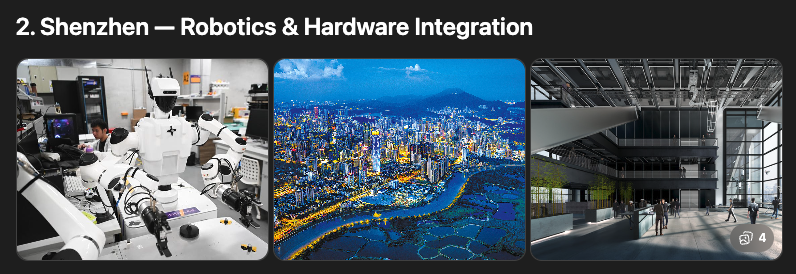
Why it matters
China has:
- the world’s largest robotics market
- the densest hardware supply chain
- massive manufacturing demand
Shenzhen is arguably the world’s fastest hardware iteration ecosystem.
Prototype → manufacturing can happen in weeks rather than months.
Major companies
- Huawei
- Tencent
- DJI
- BYD
Technology dominance
- robotics
- drones
- telecom hardware
- embedded AI hardware
Potential global shock
Affordable general-purpose industrial humanoids deployed in factories.
Strategic implication
Could transform:
- global manufacturing costs
- logistics
- labor economics

Key institutions
- Tsinghua University
- Peking University
Major companies
- Baidu
Technology dominance
- artificial intelligence
- autonomous driving algorithms
- AI chips
- advanced computing
Beijing is China’s policy + science hub.
Many national labs and strategic programs originate here.
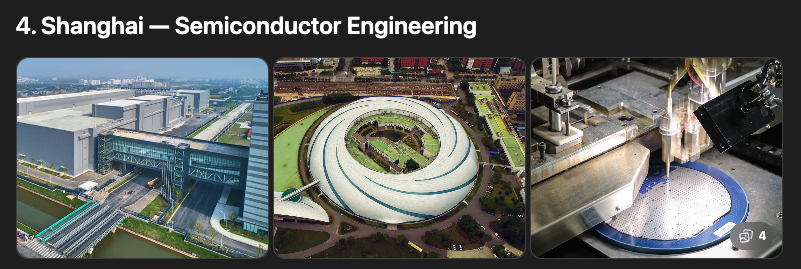
Key company
- Semiconductor Manufacturing International Corporation
Technology dominance
- semiconductor fabrication
- chip design
- semiconductor equipment
The Zhangjiang Hi-Tech Park is China’s most important semiconductor cluster.
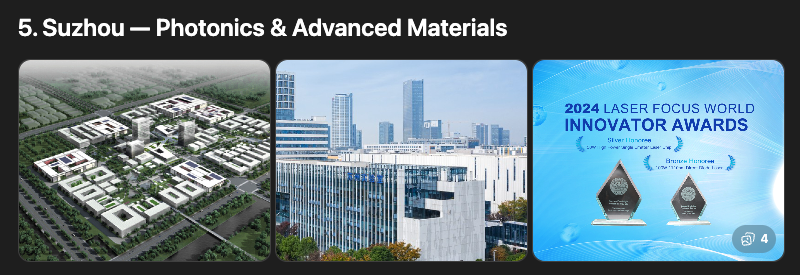
Key site
- Suzhou Industrial Park
Why this matters
Photonic chips can dramatically improve:
- AI energy efficiency
- data center performance
- telecom bandwidth
China is investing heavily in optical computing and photonic AI accelerators.
Technology dominance
- photonic chips
- nanotechnology
- precision optics
Suzhou has become one of China’s strongest photonics ecosystems.
Potential global shock
Photonic processors that outperform GPUs for certain AI workloads.
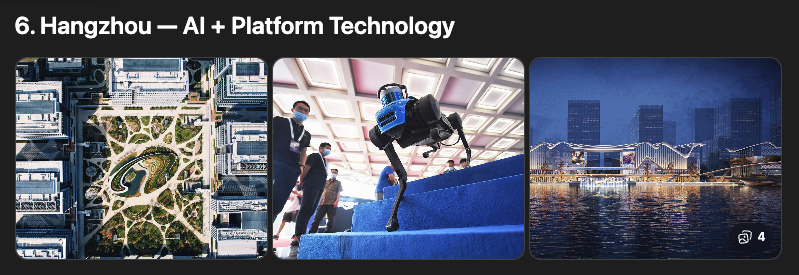
Anchor company
- Alibaba Group
Technology dominance
- cloud infrastructure
- AI platforms
- digital economy technologies
Hangzhou is China’s software + AI commercialization hub.
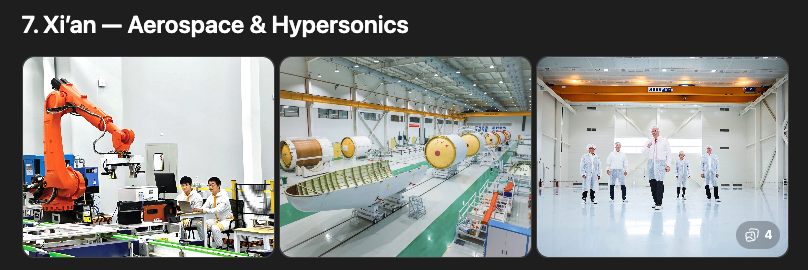
Key institutions
- Northwestern Polytechnical University
Why this matters
China has some of the largest hypersonic testing facilities in the world.
Potential global shock
Operational hypersonic aircraft or new missile systems.
Strategic implication
Major geopolitical impact on defense technology.
Technology dominance
- aerospace engineering
- hypersonic technology
- satellite systems
Xi’an is a defense and aerospace research center.
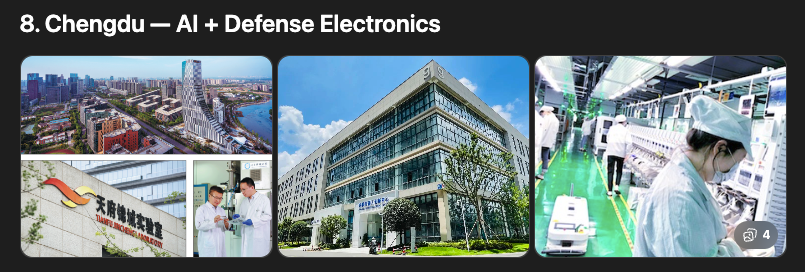
Technology dominance
- defense electronics
- AI systems
- avionics
Chengdu hosts many state defense contractors and electronics labs.
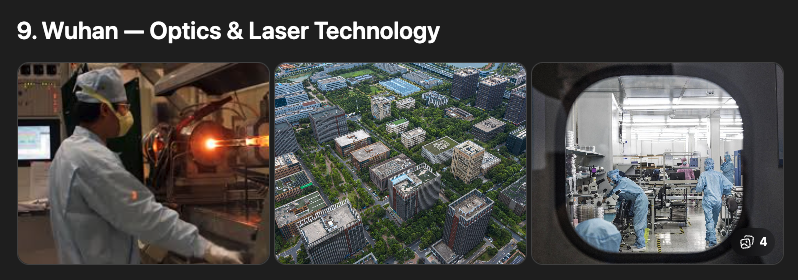
Key institution
- Huazhong University of Science and Technology
Technology dominance
- lasers
- fiber optics
- optoelectronics
The area is often called “Optics Valley of China.”
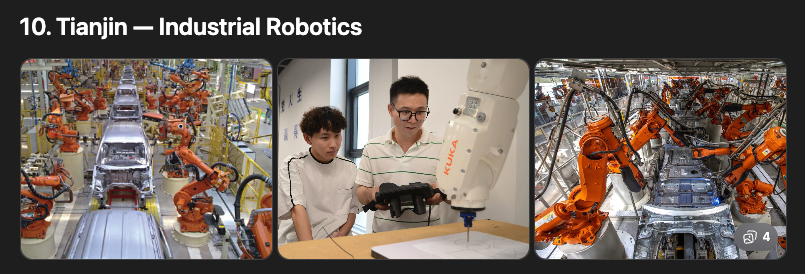
Technology dominance
- industrial robots
- advanced manufacturing automation
Tianjin focuses on heavy industrial robotics and automation.
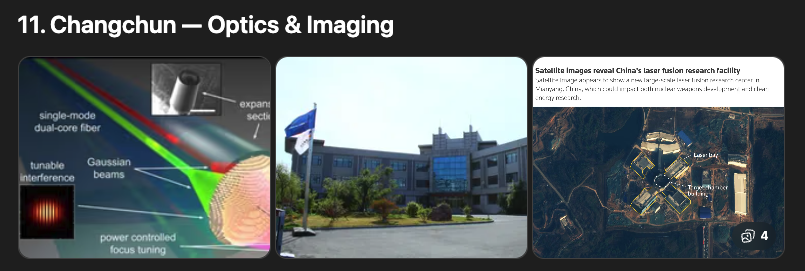
Key research hub
- Changchun Institute of Optics Fine Mechanics and Physics
Technology dominance
- satellite imaging optics
- precision optical instruments
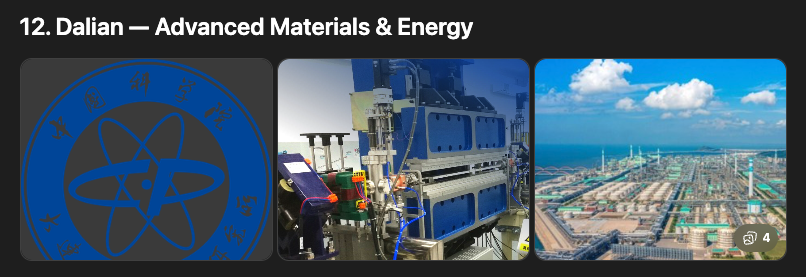
Key institution
- Dalian Institute of Chemical Physics
Technology dominance
- hydrogen energy
- catalysts
- battery materials
Key structural insight
China’s deep-tech clusters often map to different stages of commercialization:
| Cluster type | Example Cities |
| Science hubs | Hefei, Beijing |
| Engineering hubs | Shanghai, Suzhou |
| Hardware/productization hubs | Shenzhen |
| Industrial manufacturing hubs | Tianjin |
| Strategic defense hubs | Xi’an, Chengdu |
This explains why China can move technologies quickly from:
lab discovery → engineering validation → industrial pilot → deployment
BEYOND GEOGRAPHIC HUBS—THE INFRASTRUCTURE LAYER
Nuclear Fusion Engineering
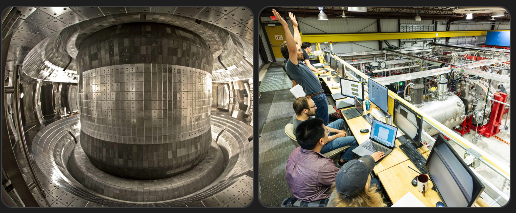
Key project: Institute of Plasma Physics Chinese Academy of Sciences:
The Institute of Plasma Physics, Chinese Academy of Sciences (ASIPP) is a leading Chinese research institute specializing in plasma physics and controlled nuclear fusion. Located in Hefei, Anhui Province, it plays a central role in China’s development of magnetic confinement fusion technologies and international fusion collaborations.
Major facility: Experimental Advanced Superconducting Tokamak (EAST)
Focus areas: Plasma physics, fusion energy, superconducting magnet technology
Role in global fusion programs
ASIPP is a major contributor to the International Thermonuclear Experimental Reactor, supplying superconducting magnet components, diagnostics, and control systems. It collaborates with research partners in Europe, Japan, and the United States, strengthening China’s participation in international fusion energy development.
Why this matters
China is building some of the world’s largest experimental fusion facilities.
AI Chips & Compute Infrastructure
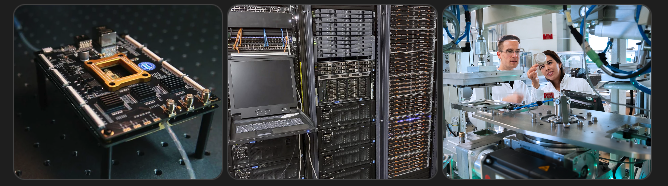
Major companies
- Huawei
- Baidu
Why this matters
US export controls forced China to accelerate domestic AI chip development.
Potential global shock
Competitive domestic GPU alternatives.
Strategic implication
Could reshape the global AI hardware supply chain.
Space Infrastructure & Satellite Networks
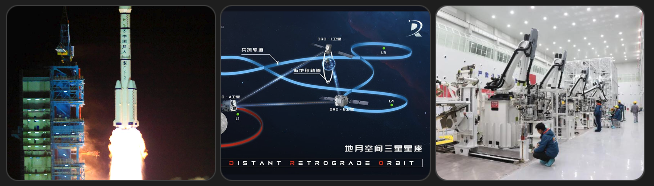
Key organization: China Aerospace Science and Technology Corporation
Why this matters
China is building large LEO satellite constellations similar to Starlink.
Potential global shock
Global satellite internet coverage competing with Western systems.
Strategic implication
New space infrastructure markets and geopolitical competition.
Strategic pattern across these sectors
China’s strongest deep-tech sectors share four characteristics:
strong state prioritization
+
large engineering teams
+
industrial supply chains
+
early pilot deployment
This combination accelerates the path from:
research
→ engineering
→ industrial pilot
→ mass deployment
Conclusion
China’s deep-tech ecosystem is structured around geographic innovation clusters, each specializing in specific technologies and stages of the commercialization pipeline. Rather than concentrating all capabilities in a single mega-hub, China has developed a network of cities that combine research institutions, industrial supply chains, venture capital, and government support to accelerate the transition from scientific discovery to large-scale deployment.
A key structural feature of this system is its strength in the engineering and industrialization stages of technology development, particularly between Technology Readiness Levels (TRL) 6–8. These stages include engineering validation, pilot production, and early deployment—areas where many deep-tech technologies face bottlenecks globally.
China’s clusters are designed to bridge this gap. Cities such as Hefei focus on translating advanced research—especially in quantum technologies—into early commercial systems, while hubs like Shenzhen specialize in rapid hardware iteration and large-scale manufacturing integration. Other clusters, including Shanghai and Suzhou, provide semiconductor and photonics engineering capabilities that support industrial scaling.
This distributed structure allows technologies to move efficiently through the commercialization pipeline:
research → spinout → engineering validation → industrial pilot → deployment
Government-guided investment, dense supply chains, and large engineering teams enable rapid iteration and early real-world testing. As a result, many Chinese deep-tech sectors advance from laboratory discovery to industrial deployment faster than in other regions.